
Topping is a popular technique in cannabis cultivation to achieve bushier plants and higher yields. But when is the right time? How do you to top correctly? And what mistakes should you avoid? In this guide, we explain everything you need to know – from the right pruning technique to the biological benefits for your plants
What is topping?
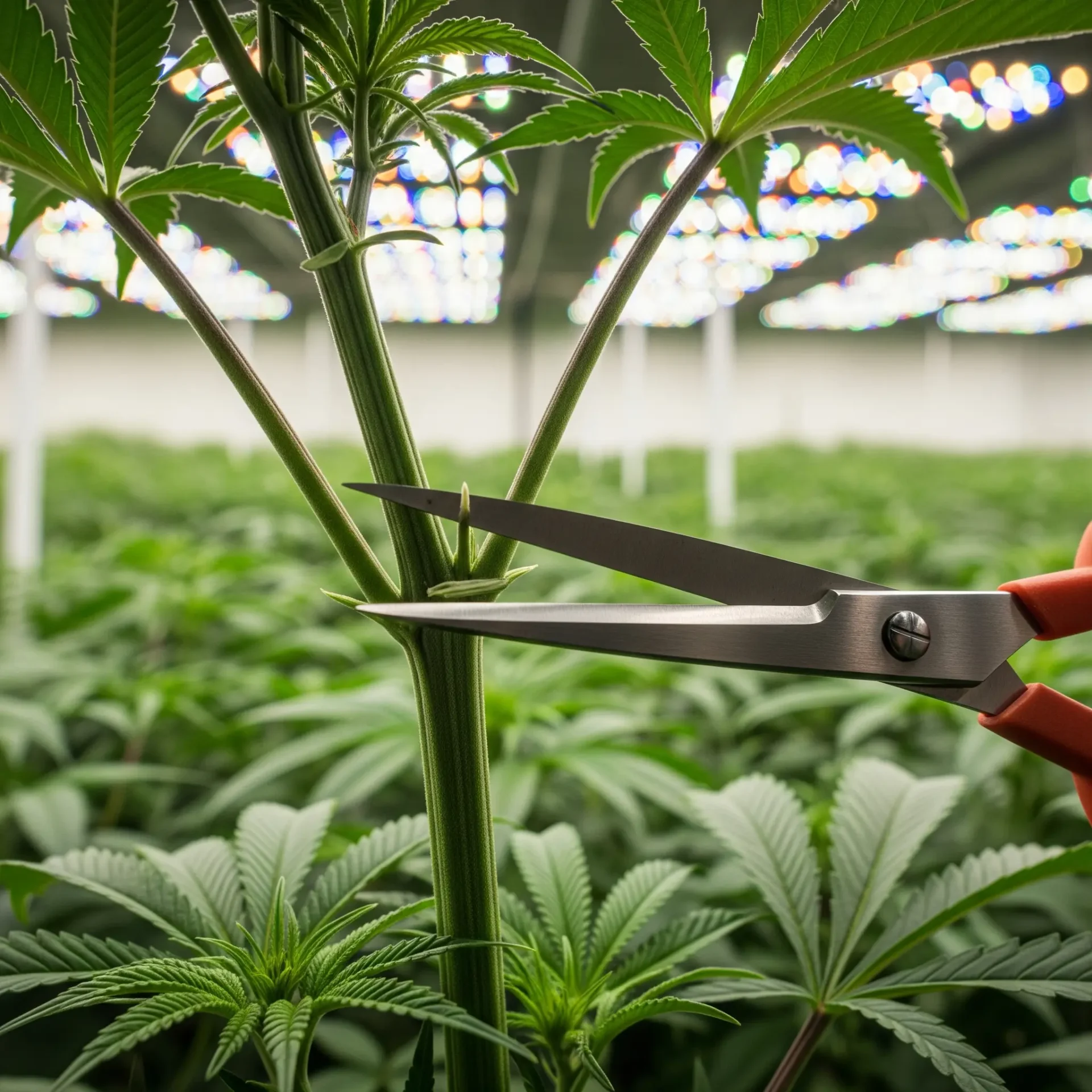
Topping refers to the targeted cutting off of the main tip of a cannabis plant in order to promote the growth of lateral shoots. This results in a bushier plant with more flowering points instead of a single main stem.
Why topping makes sense
- Better light distribution: more lateral shoots use the light more efficiently.
- Higher yields: More inflorescences = more yield per plant.
- Controlled growth: Ideal for limited cultivation areas (e.g. indoor grows).
Critical counter-question: Is topping really suitable for all strains?
No! Autoflowering strains often tolerate topping poorly because their growth phase is too short.
The perfect time for topping
Topping should be done when the plant:
- has developed 4-6 nodes (leaf nodes).
- is healthy and stress-free (no repotting or fertilizer shock).
Alternative perspective:
Some growers argue that later topping (from 6 nodes) makes the plant more stable. Experiment carefully!
Step-by-step instructions
- Sterilize tools (sharp scissors/razors).
- Cut off the top shoot above the 4th-6th node.
- Do not touch the interface (risk of infection!).
- Take care of the plant after topping (no stress, moderate lighting).
Logic check: Why not cut deeper?
Cutting too deep can overtax the plant and delay growth.
Topping vs. fimming
- Topping: Precise pruning for two new main shoots.
- Fimming: Incomplete pruning promotes 4+ shoots, but uneven growth.
Which method is better?
Topping is more controlled, fimming can be more profitable – but riskier.
Common errors
- Topping too early (plant is too weak).
- Non-sterile tools (fungal infestation!).
- Topping for autoflowers (too little recovery time).
Conclusion
Topping is an effective method for higher yields – if you master timing and technique. Try it out carefully and observe how your plants react!